
Continuing the rebuild: Why does the Arizona Cardinals offense need to start matching the team’s defense?


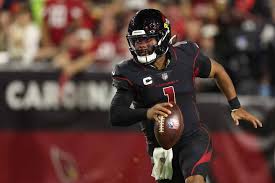
In Week 12 against the Seahawks, the Cardinals trailed by four when Kyler Murray rolled right on a fourth down, looking for Michael Wilson and instead lobbed a game-changing pick six into a defender’s arms. They lost.
A week earlier, in Week 13 against the Vikings, the Cardinals had a first down at the Minnesota 5-yard line, needing a touchdown to salt away the game, and settled for a field goal. They lost.
In Week 16 against the Panthers, the Cardinals were a field goal away from an overtime win in regulation. Their drive consisted of two incompletions toward Marvin Harrison Jr., two wasted timeouts, a delay of game penalty, a sack and, eventually, a punt. They lost, again.
Now, with one game remaining to be played, this has been the story of the latter part of their season. One missed opportunity after another in some new fashion, mostly on offense, was squandered. So, their January will be spent pondering what could have been.
It’s not that the Cardinals’ offense has been bad. They rank 14th in points, 11th in yards and 11th in expected points added per play. It has, however, been inconsistent. For every heroic play, there was a mystifying turnover. For every game-winning drive, an opportunity wasted.
We’ve been up and down,” Murray said. “. Hit here, haven’t hit here. The run game’s been clicking, pass game hasn’t or vice-versa.”
Offensive coordinator Drew Petzing gave a similar acknowledgment when asked if he’s been satisfied with the Cardinals’ offense.
Yes and no,” Petzing said. “. I think we’ve done a lot of things really well. I think we’ve put ourselves in positions and won some games based on how we’ve played, which I’m really pleased with. And I think we’ve got a lot of stuff, as always, that we’ve got to clean up and get better at.”
All of this is cause for some concern about the future.
Before the season, eight or nine wins-as the Cardinals can reach with one or two more wins-would have qualified as a big success. This was a team built to contend in 2025, not 2024.
General manager Monti Ossenfort and head coach Jonathan Gannon were hired before the 2023 season knowing the organization was devoid of talent at just about every position other than quarterback. This past offseason, they were judicious in free agency, spending like a rebuilding team, not a contending one. They kept $95 million cap space for 2025 – fourth most in the league – because that was the start of their contention window.
They are, then, a year ahead of schedule, as far as record goes. In that way, it’s reminiscent of the Detroit Lions, who jumped from three wins to nine in Dan Campbell’s second year.
But all those assumptions were built on the vision that the Cardinals’ defense would be their weakness. That group lacks star power outside of Budda Baker. It desperately needs an impact player at edge rusher and could use one at defensive tackle. A true number-one cornerback would also be helpful, although the development of Max Melton and Starling Thomas V on the outside has lessened that need.
All of those are areas the Cardinals can address with their ample cap space or in the draft. If the defense were the issue, it would be a relatively simple fix.
But here are the Cardinals’ ranks in key defensive metrics: 13th in points allowed per game, 20th in yards allowed per game, 25th in expected points added per play. Those numbers track only slightly behind the offense.
And the offense is largely a set group. The franchise quarterback (Murray) and franchise left tackle (Paris Johnson Jr.) are in place, as are the top weapons at running back (James Conner), tight end (Trey McBride) and wide receiver (Harrison). Any offseason additions will likely come at less crucial spots. Maybe a field-stretching wide receiver or an improvement at guard. Nothing drastic.
And it begs the question: how the Cardinals can take that next step — how they can recreate Campbell’s third year, when the Lions jumped from nine wins to 12 and became a legitimate Super Bowl contender.
It’s easy to image how the external additions might equate to a small jump-maybe a few pieces here and there get the Cardinals ticking up to 10th in points per game, better than playoff teams like Kansas City, Pittsburgh, and Houston.
But to realize those uncapped ceiling visions, big internal improvements are in store. The most glaring manifestation might be in Murray-Harrison development.
“We’ve gotta get better,” Murray said. “It’s not where he wants it to be, it’s not where I want to be, it’s not where this team needs it to be.”
Fixing that falls on the shoulders of Gannon, Petzing, Murray and Harrison. There is no easy solution.
“I know the impact that he can have on our team and our offense,” Gannon said. “And we’ve gotta make sure that he hits his ceiling.”
For the sake of this rebuild, the question may be crucial.