
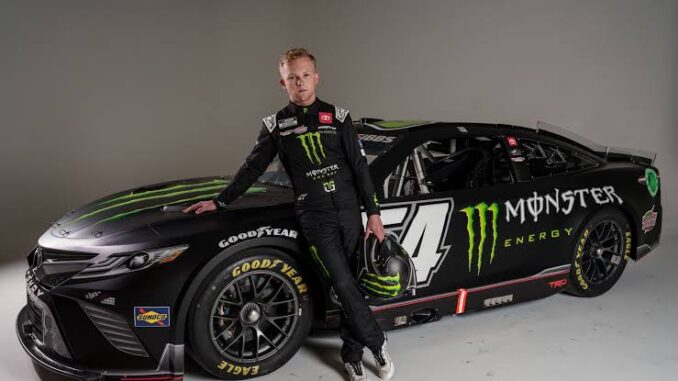
NASCAR made history with its first-ever Cup Series race in Mexico City, bringing the thunder of stock car racing to the Autódromo Hermanos Rodríguez in a bold move to expand the sport’s global footprint. Among the many standout performances in this international showcase, it was Ty Gibbs who quietly turned heads — not with a win, but with a stat that spoke volumes about his maturity, precision, and future potential.

The 21-year-old driver of the No. 54 Joe Gibbs Racing Toyota may not have taken the checkered flag, but his performance on the technical, high-elevation circuit earned widespread respect throughout the garage and beyond. What stood out? Gibbs led all drivers in green-flag passes, registering more than 50 clean overtakes throughout the race — a stat that reflects not just aggression, but racecraft and consistency.
On a track unfamiliar to most of the Cup field, where braking zones were narrow and passing opportunities limited, Gibbs showcased the kind of smart, patient driving usually seen from veterans. Each green-flag pass required precision braking, strategic cornering, and tire management — and Gibbs delivered.
“I just focused on staying smooth, making moves when they made sense, and keeping the car out of trouble,” Gibbs said post-race. “I wasn’t forcing anything, just reading the race and trusting the team’s setup.”

It wasn’t just a stat-padding run, either. Gibbs started mid-pack after a less-than-ideal qualifying session but methodically worked his way up through the field. By the midway point, he was consistently inside the top ten and eventually finished a strong sixth — his third consecutive top-10 finish of the season, solidifying his place as one of the most consistent young drivers in the series.
NASCAR’s data breakdown also revealed that Gibbs spent the most time gaining positions under green-flag conditions — not through pit strategy or luck, but pure on-track performance. That’s a trait teams and sponsors love to see, especially on a road course, where patience and planning often matter more than outright speed.
“He’s got a real sense of how to manage a race,” said Joe Gibbs, team owner and his grandfather. “Ty doesn’t get rattled. He listens to the crew, adapts on the fly, and picks his moments. That’s what impressed me the most in Mexico.”
The green-flag passing stat may not make highlight reels, but in the analytics-heavy world of modern NASCAR, it’s an indicator of both driver capability and car performance. It shows that Gibbs wasn’t just holding his own — he was actively shaping the race.
Mexico City’s unique challenges — including an altitude of over 7,000 feet — only added to the accomplishment. Engines performed differently, brakes cooled slower, and drivers had to remain physically sharp in the thinner air. For a young driver like Gibbs to thrive in those conditions speaks volumes about his preparation and fitness.
Fans, too, took notice. Social media buzzed with praise for Gibbs’ clean overtakes and poised driving style. While still early in his full-time Cup career, many now view him as a legitimate threat for a playoff spot — and perhaps even a win — before the season is over.
As NASCAR looks to build on the momentum of its first international Cup race in decades, performances like Ty Gibbs’ will be key in showing that the sport’s young talent is ready to carry the torch. He may not have won in Mexico City, but his standout stat — leading the field in green-flag passes — proved that he’s not just a driver to watch for the future.
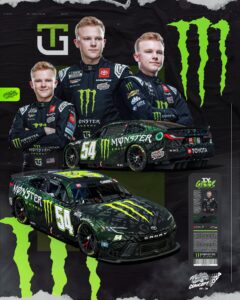
He’s already here.
Be the first to comment